Nota: El artículo se encuentra en:
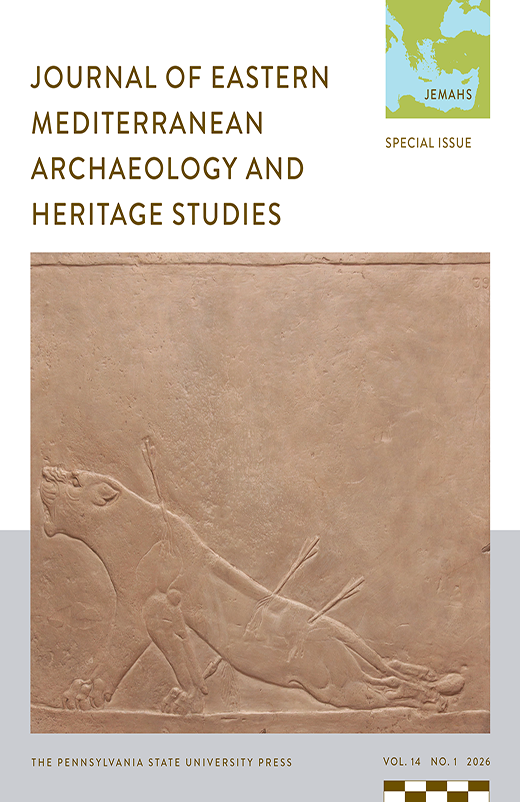
- Abstract:
https://scholarlypublishingcollective. org/psup/jemahs/article- abstract/14/1/104/408928/The- Lion-That-Flew-Away-The- Lamassu-in-the-Llotja - Article (free-access Author Link):
https://scholarlypublishingcollective. org/psup/jemahs/article/doi/ 10.5325/jeasmedarcherstu.14.1. 0104/408928/The-Lion-That- Flew-Away-The-Lamassu-in-the- Llotja?guestAccessKey= f79806e1-01b8-4dd1-a8d9- 98efb34bdfc2
The Lion That Flew Away: The Lamassu in the Llotja del Mar, Barcelona
ABSTRACT
It was an exceptional event in the Spain of the second half of the nineteenth century: The Provincial Academy of Fine Arts of Barcelona acquired a plaster replica of a large Neo-Assyrian lamassu, among other replicas, in London. The copy was the work of the Italian company Brucciani, which produced copies of and for British museums. Such purchase did not happen on a whim. The training of students of fine arts and architecture was based on drawing and the study of classical works, thanks to plaster replicas. Lessons included, from the mid-nineteenth century, detailed sessions on the art of all ancient cultures, including the cultures of the ancient Near East, when Western archaeological missions, but not any Spanish ones, were just starting in the Ottoman Empire. This article follows the history of this unique acquisition, until the disappearance of the replica, despite its size, perhaps during the Spanish Civil War.
A Winged Lion in the Llotja del Mar in Barcelona?
In the nineteenth century, the Provincial Academy of Fine Arts of Barcelona (today the Royal Catalan Academy of Fine Arts of Sant Jordi), with its headquarters in the Llotja del Mar, was home to a plaster replica of a Neo-Assyrian winged lion, which is now lost or still to be found.
Ever since Velázquez brought the first copies of artworks to Madrid in the mid-seventeenth century (Luzón Nogué 2007) and since Mengs gave his collection of molds and plaster casts to the Royal Academy of Fine Arts of San Fernando in Madrid (Negrete Plano 2009, 2013), Spanish academies and schools of art and architecture had acquired or produced plaster casts of artworks from the past. However, copies of sculptures from contexts other than the Greco-Roman world were rare; among the few examples were the reproductions of the Iberian Lady of Elche (Rebollar Antúnez 2020: 56) and of features of Islamic architecture, for example from the Alhambra (González Pérez and Rubio Domene 2018). Against this background, the existence of the plaster copy of a large Neo-Assyrian sculpture that will be discussed in this contribution is, at least as far as our current research suggests, unique for several reasons.
First, the Spanish collections that held plaster casts of Neo-Assyrian pieces were few and included only a small number of items (Garcia-Ventura 2020, 2022, 2023a, 2023b; Molinero Polo and Redondo Vilanova 2014). Second, even outside the context of the Iberian Peninsula few copies of these large pieces were circulated, most likely due to their high price and the logistical difficulties of transporting them (an aspect that will be discussed below). Despite the fact that research on plaster casts of ancient Near Eastern artifacts is still in its infancy and new findings may change our current perspective, this conjecture is supported by some evidence. In this regard, it seems telling that Germany, a country with a long tradition of ancient Near Eastern studies and a significant number of plaster casts linked to them, witnesses only one plaster cast of a Neo-Assyrian winged lion like the one found at the Llotja de Mar in Barcelona (see Rehm 2018: 142, catalog no. 47, highlighting the scarce circulation of such pieces).
Third, Spain did not have colonies in the Middle East, nor did it organize archaeological missions in the nineteenth and early twentieth centuries. Consequently, originals attesting to the material culture of the ancient Near East were also scarce in the country at the end of the nineteenth century: they were restricted to few Neo-Assyrian reliefs at the Real Academia de la Historia in Madrid (Almagro-Gorbea 2001; see Garcia-Ventura’s contribution to this special issue). The acquisition of casts by the Royal Academies of Fine Arts can be explained, first and foremost, by this lack of originals in Spain. Until the second half of the nineteenth century, when the cast of the Neo-Assyrian piece reached Barcelona, the training of artists and architects was the responsibility of the Academies of Fine Arts. Both training programs shared curricula, and art history courses included classes on all ancient and modern cultures. As the study and copying of works from the ancient Near East were also part of the training of painters, sculptors, and architects, such casts were necessary.
Taking into account these different aspects of the circulation of originals and copies of Neo-Assyrian pieces in the Spanish context, the present article traces the history of the plaster replica of a Neo-Assyrian winged lion acquired by the Provincial Academy of Fine Arts of Barcelona at the end of the nineteenth century. This replica is now missing or, at least, is yet to be found. First, as background, we offer an overview of the historical background of Fine Arts studies in eighteenth- and nineteenth-century Spain, paying special attention to the situation in Barcelona. Second, we take up the story of the acquisition of the Neo-Assyrian winged lion for the Llotja de Mar, discussing its role as plaster cast for educational purposes as well. Third, we focus on its current situation, explaining the avenues of investigation that we have opened to try to find a piece that was very relevant at the time but is currently missing.
The First Academies of Fine Arts in Spain
The Spanish War of Succession ended in 1717 with the ascent to the throne of a new dynasty of French origin and the reorganization of the Kingdom of Spain. This led to the closure of the Estudios Generales (as the universities were known at the time) of the former lands of the Crown of Aragon, which had mainly supported the Habsburg dynasty, to be replaced by a single Estudio General, located halfway between Madrid and Barcelona. The city of Cervera, which supported the new Bourbon king, Felipe V, was chosen as the site of the new Estudio General of the principality (that is, the former lands of the Crown of Aragon).
The closure of the Estudios Generales did not diminish the cultural life of the city of Barcelona (Fernández 2014). In fact, it gave rise to a new model of higher education. Shortly after the end of the War of Succession, this new model was promoted by the Board of Trade of Barcelona, with royal permission. It included courses in the Noble Arts, devoted to the training of painters, sculptors, and architects who were able to compose motifs that would later be printed.
The study of Noble Arts, which would later be taken over by the Academy of Fine Arts in the nineteenth century, followed the study programs of the Royal Academy of Fine Arts of San Fernando in Madrid. This was Spain’s first academy devoted to the arts. The academies were centers of teaching and of political debate, and they were also museums; their triple mission was to serve as places of discussion, training, and collecting (Chocarro Bujanda 2007). They housed exemplary works of art that aspiring artists and architects would study and imitate as part of their intellectual and technical training. Alongside the Royal Academy of Fine Arts of San Fernando in Madrid, the institutions authorized to judge artistic projects included the Academies of Fine Arts (also known as Academies of the Three Noble Arts) of Valencia (founded in 1768); Santa Isabel de Hungría in Seville (1771), heir to the Seville Academy of Painting founded by Murillo and Valdés Leal, among others, in 1660; Cadiz (1777); and San Luis in Zaragoza (1792).
The Provincial Academy of Fine Arts in Barcelona was not on this list. Nonetheless, this institution took on the educational role expected of an artistic academy, and the city’s Board of Trade set up the Free School of Design, housed in the building of the Llotja del Mar (Marés Deulovol 1974; García Melero 1997: 166; Ruiz Ortega 1999). The Free School carried out the functions of an academy but offered courses both in fine arts (to which architecture was added in 1817) and in applied arts. In fact, its main function was to train specialists in the design of prints. The school became the School of Fine Arts in 1778 and then the Provincial Academy of Fine Arts of Barcelona in 1850, when it took on the teaching of the study plans of fine arts and architecture of the Royal Academy of Fine Arts of San Fernando in Madrid.
The academies in general, and the School of Fine Arts of Barcelona in particular, gave pride of place to exemplary models of composition and expression (Riera Mora 1994), aesthetic and ethical models, religious and mythological figures, paradigmatic examples of ancient cultures worthy of study and imitation, items from cabinets of curiosities, and testimonies to divine inventiveness in the incessant creation of ever-new natural forms (Enguídanos López 1794). As part of this process, plaster casts of statues and fragments of architecture from classical monuments and sites were made (Kockel 2010).
But what happened to the reproductions of works from outside the Greco-Roman, Iberian, and Arab worlds? Were these nonclassical works worthy of study? The answer to the second question appears to be yes: The Catalogue of the Stocks of the Library of the Drawing School [of Barcelona] in the Cabinet on the Left upon Entering, bearing an early date, between 1800 and 1809, includes “No. 81: twelve volumes: Ancient history of the Egyptians, Assyrians, Babylonians, Medes, Persians, Macedonians, Greeks, Carthaginians and Romans” (Arxiu catalogat-transcrit RACBSJ: 8).1 Therefore, books on the history of the Assyrians, Babylonians, Medes, and Persians in the library of what would become the Provincial Academy of Fine Arts in Barcelona were granted the same level of importance as texts on the Greeks and Romans. The culture of Egypt was also a subject of interest, at a time when Napoleon’s Egyptian campaign had recently come to an end.
The study plan for architecture of 1855, taught only at the Royal Studies of San Isidro in Madrid, under the supervision of the Royal Academy of Fine Arts of San Fernando, also promoted the history of art beyond the confines of the Greco-Roman framework. The plan advocated the study of examples “that were produced by the Oriental genius” or “the monumental constructions of all centuries, analyzed fruitfully, came to dispute with Greco-Roman architecture the exclusive possession of our lecture halls” (Gazeta de Madrid, January 27, 1855).2
In the second half of the nineteenth century, classes on the art and architecture of the ancient Near East offered the most detailed and comprehensive overview imaginable at the time. Assyria, Persia, and Babylon were the “Oriental” cultures that were the focus of attention. In fact, two centuries earlier, in 1643, the study plan of the Colegio de San Idelfonso de Toledo, in Madrid, already included advanced studies in Chaldean and Syriac (Miguel Alonso 2018: 56–57).
The lists of the courses in the study plan for architecture of 1855, reproduced below (Programas . . . 1855: 142–44), bear witness to the range of knowledge expected of students of fine arts and architecture:
FOURTH YEAR
PERSIAN ARCHITECTURE
Iran or Persia
Lesson XIX.
History and particular considerations of this country.
Chronology of distinctive moments and general characteristics.
Classification of the same.
Lesson XX.
Religious. Temples and fire altars, temple-like grottoes, the oratory of Ormuzd.
Funerary. Rock-cut tombs, the tomb of Nakschi Ruitan, rotating columns.
Civil. Palaces, ruins of Persepolis, royal chambers, ruins of Chapur, houses, canals, and other buildings.
Military. Walled enclosures and forts.
Lesson XXI.
Sculpture, painting, inscribed cylinders, and other objects of art.
Comparative examination of Persian architectural monuments.
Was architecture in Persia original or imitative?
What natural or accidental circumstances influenced Persian style architecture?
Analytical comparison with buildings built in other countries in earlier times.
ARCHITECTURE OF OTHER PEOPLES OF ASIA
Babylonians, Chaldeans, Medes, Syrians, Phoenicians, and Hebrews
Lesson XXII.
History and general considerations of these countries.
Chronology and general characteristics of the monuments.
Classification of the same.
Lesson XXIII.
Babylon.
Religious. Temples of Belo, the Birs-Nimrud.
Funerary: Sepulchres and tombs.
Civil. Palace of Semiramis, houses, streets, bridges, and hanging gardens.
Military: Enclosures of Babylon, walls, and forts.
. . .
FIFTH YEAR
Lesson XXIV.
. . .
Syria.
Ruins of Baalbek, Palmyra, hypogeums, walls of Antioch, remains of Heliopolis, ruins of Nineveh.
To better understand the choices made in this list of courses, it is worth stressing that archaeology was considered a science, and archaeologists in Spain in the second half of the nineteenth century were considered professionals (Mora and Ayarzagüena Sanz 2004). Moreover, although this syllabus of art history of the ancient Near East for architecture students dates from 1855, it was undoubtedly written earlier. The first French archaeological missions in what is now northern Iraq, carried out by Paul-Émile Botta, date from 1842, while the first British excavations under William Kennett Loftus began in 1851. As a result of these first archaeological expeditions, shortly before the drafting of the 1855 syllabus, the first Neo-Assyrian works had reached the Louvre and the British Museum, and in fact the two institutions were involved in a dispute over the possession of these works from the ancient Near East and the right to exhibit them (Roman 2021).
So, the design of the study plan coincided with the early stages of the development of Western archaeology in the Near East. Spain was not involved in these archaeological campaigns, but the ruins of Palmyra and Persepolis had been explored and drawn by Western adventurers, diplomats, and artists since the sixteenth century (leaving aside for the moment the first travelers from the Caliphate of Córdoba before the tenth century; see Pérez Die and Córdoba Zoilo 2006), and the well-known classical and biblical texts referring to Babylon, Assyria, and Persia were the documentary sources of the courses on the Near East contained in the study plan. Without these classical references, there would have been no classes on the palace of Queen Semiramis, a recurring theme in the European artistic imagination, from essays to operas, from the Middle Ages onward (Droß-Krüpe 2020; Azara 2024b).
A Unique Plaster Cast at the Provincial Academy of Fine Arts in Barcelona
After this description of the cultural background, we now take up the story of the acquisition of the unique plaster copy of a Neo-Assyrian relief or wall sculpture by the Provincial Academy of Fine Arts in Barcelona.
This replica was acquired from the private London firm Brucciani & Co., of Italian origin, which manufactured plaster copies of original works in museums in the United Kingdom, in particular the British Museum (Wade 2018). The copy under analysis here was of a Neo-Assyrian winged lion or lamassu (to use the Akkadian term; on lamassu, see Foxvog, Heimpel, and Kilmer 1980–1983; Spycket 1983; Bujanda 2014: 5–21; Danrey 2004: 309–49). The precise linear drawing, a side elevation view of this replica, is reproduced in a company catalog of plaster copies of original works in marble and bronze printed in 1867 (Brucciani 1867: 5). The copy is accurately described as a “Human-Headed Winged Lion” and is cataloged under number 41. This replica is no longer produced today; the molds are excessively worn, and in fact Neo-Assyrian reliefs and sculptures are now replicated with 3D printers.
The original statue from which this replica was made reached the British Museum in 1850. Sir Austen Henry Layard writes in his book Nineveh and Its Remains (Layard 1849: 2:XI, 7) that the statue was going to be sent to London, even though, according to the same author (Layard 1849: 2:XIII, 74), the British museum had not asked to remove the work from the site. The original was inventoried in the British Museum under no. 118873 (although it may possibly be the work inventoried under no. 118871), where it is still standing in the permanent collection of the Department of the Middle East.3
The lamassu is a large wall relief, 317 cm high and 281 cm wide. Carved in limestone and facing right, it comes from the Northwest Palace of Nimrud in northern Iraq. It is dated to the reign of Assurnasirpal II (865–850 BC). It was found by the mission led by Layard in 1847, possibly by Hormuzd Rassam, a Christian from Mosul who was responsible for the main finds attributed to Layard (Amin 2023: 25–42). The pair of the winged lion with a human head—or a human with a winged lion’s body—of the British Museum is in the Metropolitan Museum of Art in New York (Gift of John D. Rockefeller Jr., 1932, inv. no. 32.143.2) (Collins 2012: 82 n. 3).
As no documentation of the sales of casts from Brucciani (such as the one discussed here) is preserved, it is impossible to keep track of the supply of these pieces from an archival point of view. However, the archives of the Provincial Academy of Fine Arts of Barcelona attest to this transaction. Indeed, the institution acquired the replica of the British Museum lamassu in 1874 or 1875, as recorded in the documents translated here (Arxiu catalogat-transcrit RACBSJ: 2044):
The Academy pays D. Claudio Lorenzale 815.80 pt. for purchases made on his trip to Italy. These purchases will probably be the objects brought by the steamer Arethuse:
176 kilos of plaster models [“plaster models” in English in the original], brought by steamer, which must correspond to casts from the British Museum (in the hall).
1 piece of plaster, part of a sphinx (which must be the Assyrian winged bull [sic]), also brought from London. The draft of Mr. Ferrán’s certificate contains the same previous indication, “which is brought for the teaching of courses at the Schools.”
This copy of a Neo-Assyrian winged lion with a human head, together with other plaster copies, was placed against one of the walls of the Museum of the Royal Provincial Academy of Fine Arts, after the renovation of the building (Fig. 1a and 1b), as the following report affirms (Soler Pérez 1903: 10, 12):
Museum. The three rooms occupied by the museum of the Academy, in the original distribution of the School premises, have been assigned to the School when the paintings were transferred to the museum created by the Provincial Council and the City Council. Two of the rooms are occupied by the classes in Artistic Drawing and Perspective and the other, larger one, which is surrounded by a high gallery and is illuminated by overhead light and was used to display the admirable Life of Saint Francis by Viladomat, now houses the museum and the new library.
The museum contains large casts of works from the British Museum and the School of Fine Arts in Paris, which were once acquired by the Academy of Fine Arts for teaching purposes and represent Egyptian, Assyrian, Greek, and Renaissance sculpture. They are accompanied by large display cases, which hold Etruscan vases and Japanese and Moroccan costumes, fragments of fabrics from the sixteenth to the eighteenth centuries, and reproductions of weapons, ivory, candlesticks, goblets, plates, door fittings, crosses, and Pompeian lamps, all objects purchased with an extraordinary consignment made to the School in 1874 by the Provincial Council. This room will also serve as a lecture hall and a meeting room for teachers.


General layout (A) and detail (B) of the Provincial Academy of Fine Arts of Barcelona, showing the location of the “Assyrian bull” in the new museum rooms of the Academy (Soler Pérez 1903). (© Biblioteca-Archivo de la Reial Acadèmia Catalana de Belles Arts de Sant Jordi [RACBASJ], Barcelona.)
Let us summarize the quotes from the Archive and the Report just mentioned. In 1874, the Provincial Council—a Spanish political institution that represents the central government in each of the provinces which still today make up the Kingdom of Spain—granted 815.80 pesetas to the director of the Academy, Claudio Lorenzale, for the purchase of replicas of works of art and all kinds of antique decorative art such as lamps, fabrics, costumes, plates, and more from Egypt, Assyria, Greece, Pompeii, as well as modern works from other cultures such as Japan and Morocco. These purchases, for a present-day value of 3,786.38 euros,4 were made in Italy, France, and England.
The price of the plaster replica of the winged lion with a human face (lamassu) was 15 pounds sterling, as specified in the Brucciani & Co. catalog of replicas of 1867. The equivalent in today’s money would be 2,015 euros. There would have been 1,771.38 euros left for the purchase of the rest of the replicas, reproductions, fabrics, and costumes, had the acquisition of the casts from London not exceeded the budget due to “packing and freight costs.” Nonetheless, the increase in cost was approved (Governing Board of February 5, 1875; Llibre d’Actes de la Reial Acadèmia . . . 1872–1885: 82).
The size of the wooden boxes in which the plaster casts were sent from London to Barcelona made their storage impossible, as the Academy lacked the necessary space. Furthermore, the wood from which the boxes were made was combustible. For these two reasons the boxes were sold for a price set at 100 pesetas (today 495.23 euros), to be deducted “from the carpenter’s account”; their sale means that some potentially useful information was lost (Llibre d’Actes de la Reial Acadèmia . . . 1872–1885: 98).
In the case that concerns us here, the copies of antiquities were made in London by Brucciani & Co. These casts, as mentioned in the text of the archive, were transported by the French steamer Arethuse, which probably belonged to the Compagnie des Messageries Maritimes.5
According to África Tiñana, a technical expert at the Museum of the Royal Catalan Academy of Fine Arts Sant Jordi in Barcelona, this steamer left from a port in Normandy or Brittany in France and docked in the port of Bilbao. Previously, transport had been carried out by rail or road from London and, once in Spain, from Bilbao to Barcelona. The transport must have been carried out by freight train rather than by road, as the railway network was already functioning (Vidal Raich 1994) and the Bilbao–Barcelona line was completed in 1868. In any case, in the midst of the Third Carlist War (1872–1876), the journey by road would have been unsafe; what is more, the road that linked Bilbao and Barcelona was not part of the main network of the Caminos or Calzadas Reales that extended outwards from Madrid in a radial fashion. This was two years before the Law on Roads was approved. The road was made with cobblestones, and the vehicles that circulated were horse-drawn carriages, which would have been unsuitable for the transport of large plaster casts.
The Purpose of the Plaster Copies at the Provincial Academy of Fine Arts of Barcelona
As will be clear from the quotes below, the Provincial Academy of Fine Arts of Barcelona’s motivation for acquiring plaster copies of classical and Egyptian pieces and one Assyrian piece was strictly educational (Azara 2024a). The purpose of the copies was to aid “the teaching carried out at the Schools” of Fine Arts and of Decorative Arts: “The Academy [bought] models for the courses given at the School,” specified the director of the School, Manuel Vega y March in 1925 (Vega y March 1925: 444). Furthermore, the director also specified that the casts were key “to continue the industrial tradition of Catalonia and contribute to the revival of the renowned industrial arts of the national history” (Vega y March 1925: 439–40). However, in addition to these political and functional aspects, the practice had an aesthetic purpose that should not be overlooked, as asserted already in preceding decades by the following text from the meeting of the Governing Board of the School, held August 23, 1875: “In view of the arrival of the casts from the British Museum [in London], it was decided that they would be placed in the hall or anteroom of the classrooms and in the sculpture room, forming a group with the Assyrian casts and another with the Greek ones, and entrusting the Director of the Museums with the task of executing this agreement” (Llibre d’Actes de la Reial Acadèmia . . . 1872–1885: 92).
The museum room, which was designed to house works of art and also contained the then so-called new library, underwent modifications (Vega y March 1925: 443). The renovation involved not just a redistribution of the artworks but a reduction of the space dedicated to the museum, which now had only one room instead of three. Part of the painting collection was moved “to the Museum created by the Provincial Council and the City Council” (Vega y March 1925: 443)—the Palace of Fine Arts, built for the Universal Exhibition of 1888, in the Ciutadella Park. The hall of the Museum of the Provincial Academy of Fine Arts, in the Llotja del Mar, was square; it had two main areas and a gallery running around the perimeter, allowing visitors to see the paintings displayed there, among them The Life of Saint Francis (ca. 1729) by the Spanish Baroque painter Antoni Viladomat.
The emphasis on museography and the presentation of works of art—replicas considered aesthetically, and as autonomous entities—aimed to delight the senses, as stated in the following excerpt from the Governing Board of the School, held August 23, 1875:
In the Ancient and Natural Drawing classrooms, the hemicycles have been removed to provide more freedom and to allow the positioning of easels. Instead of one statue, there are several in front of three walls, and the fifty students in the Ancient Drawing class last year copied one of them. . . .
And the current classrooms are no less beautiful, although small; the whiteness and coldness of the plaster models is interrupted and contrasted by the varied colors of the fabrics, glass, tiles, butterflies, stuffed birds, and plants, which profusely fill the room, with the Auer or electric lamps and the easels. (Vega y March 1925: 441–42).
The whiteness of the plaster was a canvas onto which all kinds of colored reflections were projected, emanating from the polyphony of metal objects, glass, fabric, feathers, glazed ceramics, and plants. Perhaps the plaster casts had to be white for aesthetic rather than material reasons; the interplay of light and color prioritized the surface of the objects over their shape. The projections and reflections created an enchanted space in which each object seemed to occupy its proper place, contributing to a harmony almost reminiscent of Art Nouveau or the Arts and Crafts movement.
The museum was a place for admiring works of art, but it also played an active role in the training of students; it hosted the artistic drawing class, in which the students sat on stools in spite of the lack of space, drawing plaster replicas on sheets supported by boards mounted on wooden easels (Vega y March 1925: 433). In one of the photographs that illustrate Vega y March’s text, a student can be seen drawing the lamassu, which was attached to the wall (Fig. 2).

Students at the class of artistic drawing held at the Museum of the Provincial Academy of Fine Arts of Barcelona (Vega March 1925: 433). (© Biblioteca-Archivo de la Reial Acadèmia Catalana de Belles Arts de Sant Jordi [RACBASJ], Barcelona.)
When training students of fine arts, architecture, and decorative or applied arts, emphasis was laid not only on painting and creating sculptures that copied real-life objects but also on textiles, metalwork, and glasswork. This emphasis was not exclusive to the Provincial Academy of Fine Arts of Barcelona; in fact, it complied with “the decrees [of the Government] of January 4, 1900, [which] provide that models be copied from the first stages of education, and that direct copying of reality, both that created by nature and that invented by art and industry, be introduced in the subsequent stages.” (Vega y March 1925: 439). The drawing of plaster copies of works from the past or of works from far-off parts of the world had been a required part of the academic training of painters, sculptors, and architects since the eighteenth century, the period when the first Spanish academy, the Royal Academy of Fine Arts of San Fernando, was created (García Melero 1997: 168).
On August 12, 1875 (the year in which the lamassu replica was purchased by the Provincial Academy of Fine Arts of Barcelona), the Gazeta de Madrid published a description of the curriculum for the degree in architecture. Regarding the role of drawing, it stated the following:
Higher School of Architecture, Federico Aparici, secretary. Drawing comprises the following four sections: line drawing, with the necessary extension to train students to draw and wash an architectural piece [the verb “wash” refers to the use of water in painting, i.e., watercolor]; figure drawing up to copying plaster heads, or a whole figure from relief; copying ornamentation and architectural fragments from plaster; and drawing of washed and watercolored architectural details. (Gazeta de Madrid, August 12, 1875, 417)6
Thus, “students who enroll . . . in the history of architecture must study detailed and plaster drawing, aesthetics, and the aforementioned subjects (shade, perspective, gnonomics, and stereotomy of stone” (Anonymous 1875: 9). A description of the classroom where the plaster replicas were displayed preceded this statement: “The specialist press highlighted above all the construction of rooms expressly intended for plaster copies” (Anonymous 1875: 8). This comment refers to the renovation of the Imperial College of Madrid (today a school housed in the former Jesuit college) where the School of Architecture was set up after its separation from the Royal Academy of Fine Arts of San Fernando in 1875. The renovation was undertaken by the architect Francisco Jareño Alarcón, director of the School, and a member of the Academy.
The lamassu plaster cast played a significant role in the training of students of fine arts and arts and crafts at the Provincial Academy of Fine Arts in Barcelona. Its importance is reflected in the wording of the final exams of the 1924–1925 academic year and in the answers of the students, transcribed in the Academy’s archives (Arxiu catalogat-transcrit RACBSJ: 2824, 2990–93, 2995–99, 3001, 3003, 3005). The students were asked to design three works, one architectural, one sculptural, and one pictorial: the image of the sculptural group of Laocoön and His Sons, and the painting La Magdalena by José Ribera “El Españoleto,” preceded by the image of an Assyrian temple or palace in Khorsabad. All the answers to the architecture question mention a winged bull or “large winged bulls . . . at the main door of each of the palaces.” Students described the figures as “emblem(s) to scare away the spirits; each of their towns had a favorite animal.” The “winged bulls with human heads (which symbolized the flight of the eagle, the strength of the bull, and the intelligence of man) played the role of guardians of the temple.” The students’ answers in the various exams are similar and undoubtedly replicate the teaching that they had received (and internalized well).
In the twentieth century, the plaster copies were largely ignored, but now, in the twenty-first century, the few that have survived have been reinstated and have aroused interest among scholars. In the nineteenth century they were valued and appreciated, and the fact that they were copies was of no consequence (Azara 2023). In fact, the copy room was the most important part of the restored School of Architecture.
In Search of the Lost Lamassu
Given the interest in plaster copies of sculptural and architectural works from the past, what is the current situation of the replica of a Neo-Assyrian winged lion with a human head in the Royal Academy of Fine Arts of Sant Jordi in Barcelona in the Llotja del Mar, or in one of the two sites of the School of Arts and Crafts, separated from the Royal Academy after more than a century sharing space in the Llotja?
The answer is short and to the point: The replica of the lamassu is nowhere to be found. It must be lying abandoned in some municipal warehouse or kept secretly in some private collection; or, perhaps, it has been destroyed. Today there is no trace of this cast measuring more than three meters high by two meters wide. Not even the oldest historians among us, either from the Academy or from the Schools of the Llotja, remember ever having seen the work. Nevertheless, its acquisition is reported in the transcribed documents cited above from the Provincial Academy of Fine Arts of Barcelona (Arxiu catalogat-transcrit RACBSJ: 2044). Its presence in the Academy is indicated in the floor plan of the institution published in 1903 (Soler Pérez 1903). Also, two photographs of the museum, taken in 1902 and 1925, show the replica in its place in the museum (Fig. 3). In the 1925 photo the cast appears to be in good condition (Soler Pérez 1902: 142; Vega y March 1925: 433).

Lobby of the Central School (Casa Lonja). Hall dedicated to the Museum and School archive (Soler Pérez 1903: 145). (© Biblioteca-Archivo de la Reial Acadèmia Catalana de Belles Arts de Sant Jordi [RACBASJ], Barcelona.)
And finally, Carles Fargas Bonell (1883–1942) the owner of a well-known chocolate and pastry shop in Barcelona, still in existence today, and a renowned photographer of Barcelona’s social and cultural life in the early twentieth century, took two black and white photographs, on a glass plate printed in gelatin silver, of the Museum of the Provincial Academy of Fine Arts in Barcelona around 1917 (Figs. 4a, 4b, and 5). One is a single exposure photograph, but the other is double exposure, creating a stereoscopic image, a technique that Fargas cultivated (García Felguera 2011).


Photographs (gelatine and silver on glass) by Carles Fargas Bonell showing Egyptian sculptures at the Llotja de Barcelona building, ca. 1917. (© Arxiu Fotogràfic Centre Excursionista de Catalunya, Barcelona, AFCEC_FARGAS_X_01058.)

Photograph by Carles Fargas Bonell showing a plaster cast of a lamassu, ca. 1917, at the Provincial Academy of Fine Arts of Barcelona. (© Fundación Instituto Amatller de Arte Hispánico, Barcelona.)
Both photographs are of the plaster replica of the lamassu. It appears placed on a pedestal attached to a wall, flanked by two plaster copies of full-length Egyptian statues, one standing and the other seated, also on pedestals. There is also what appears to be a copy of a metope from the Parthenon, facing a plaster copy of a classical Venus, naked, without arms.
In the photograph published in 1902 the lamassu replica appears alone. In the later 1925 photo, in contrast, it stands between the Egyptian plaster replicas which, like the lamassu, would have been acquired in 1875. In another printed photograph, at least one of the Egyptian replicas (the seated figure) can be seen attached to the back wall of the Classroom for Drawing from Antiques (Vega y March 1925: 152). At least one Egyptian replica must have moved to the museum and placed next to the lamassu.
Given the photographic and written evidence—admittedly scarce, but some of it printed in local publications—how is it that this plaster replica of a Neo-Assyrian winged lion has gone unnoticed and has disappeared from our memory?
The arrival at the Provincial Academy of Fine Arts of Barcelona in 1875 of a box of considerable dimensions from London left no traces in Barcelona printed records of the day. There are also several problems of identification. Recall that, in the minutes, the replica was described as a sphinx—it was stated that it was probably the replica of a winged “bull” (another identification error). The photographs by Carlos Fargas are entitled: “Egyptian sculptures in the building of the Llotja in Barcelona.” This title (which, in fact, almost dissuaded us from looking at the images) is not actually wrong, since the photograph does include two replicas of Egyptian statues, but it is obviously incomplete, since the replica of the lamassu is the main point of interest of the image.
The uncertainty surrounding the fate of the plaster copy, however, is probably due more to historical events than to the title or description of the work. The Llotja del Mar building was occupied during the Spanish Civil War 1936–1939 (Bassegoda 1992). “It is known that, during the War, and more specifically during the events of May 1937, the Academy and the entire Llotja building were occupied by military forces that did not abandon the premises until June 11” (Fontbona 1999: 23). The documentary losses were considerable. However, the absence of documentation is not exclusive to Spain. In London, neither the Victoria and Albert Museum nor the British Museum have any record of transactions with the Provincial Academy of Fine Arts of Barcelona.7
The School of Fine Arts separated from the Academy after the Spanish Civil War. The plaster cast was in the Academy museum, but given its educational function we can assume that if it was still in existence in 1940, it may well have been moved to the new headquarters of the School of Fine Arts, the Borsí building, which had to close in 2009 due to serious structural problems. At present the building is under renovation, but the replica was not inside.
A further separation occurred with the division of the School into the Schools of Fine Arts and Arts and Crafts, in 1940. The School of Arts and Crafts left the Borsí building and moved to two new sites, in two different neighborhoods, one in Sant Gervasi and the other in Sant Andreu. Some plaster copies were transferred to these two buildings, and more still in 1991 with the foundation of the Higher School of Conservation and Restoration of Cultural Assets of Catalonia, in a new location, which housed some of the plaster replicas originally in the Academy. The replica of the lamassu is not to be found in any of these buildings. Could it have survived so many moves?
Finally, the Royal Academy of Fine Arts of Sant Jordi has undergone such a comprehensive reorganization that it is difficult to identify the original location of the plaster replica of the lamassu at the end of the nineteenth century and beginning of the twentieth. The square-shaped room of the museum no longer exists: Walls have been knocked down and false ceilings have been installed. Nothing remains that might recall the past existence of the museum and its collections.
To summarize: The initial misidentification of the cast, the losses due to the Civil War, the upheavals caused by the renovation of buildings, the to-ing and fro-ing of schools and academies, and the disdain for plaster casts throughout the twentieth century (Azara 2023) may go some way to explaining the disappearance of possibly the only plaster replica of a large ancient Near Eastern work of art and the only full-size replica of a lamassu in Spain.
So, hoping against hope, perhaps, we will continue our investigations. Who knows if one day our research will bear more fruit.
Notes
Acknowledgments: The authors thank Carolina García Estévez (Polytechnic University of Catalonia, Barcelona), Paul Collins (The British Museum), Victoria Durá (Department of Archives, Library and Publications, Royal Academy of Fine Arts, Madrid), Harriet Braine (Victoria and Albert Museum), Sophie Prieto and Arielle Lebrun (Ateliers de Moulages de la RMN, Paris), Clara Garicosa, Anabel Vilallonga, Laia Figuerola, and Alicia Viver (Llotja Sant Andreu, Barcelona), Judit Gabriel and Nuria López (Escola Llotja, Barcelona), Susana Feito and Andrés Vázquez (School Library Archive Technical School of Architecture of Madrid), Berenguer Vidal (Centre Excursionista de Catalunya, Barcelona), and especially Africa Tiñana Mbuña (Reial Acadèmia Catalana de Bellas Artes de Sant Jordi, Barcelona), Michael Maudsley for the translation and corrections, and Agnès Garcia Ventura for her advice and corrections.
All translations from Spanish are the authors’. This must be the 13-volume work published repeatedly since the eighteenth century and translated into English, written by the Frenchman Charles Rollin between 1748 and 1769: Histoire ancienne des Egyptiens, des Carthaginois, des Assyriens, des Babyloniens, des Mèdes et des Perses, des Macédoniens, des Grecs, published in Paris, Chez la veuve Étienne. The edition in the library of the Free School of Drawing in Barcelona is probably the one published in 1805 by Huet-Levacher.
Parte oficial. 1a Sección – Ministerios. Ministerio de Fomento. Exposición a S.M., Gazeta de Madrid, no. 756, Saturday, January 27, 1855, n.p. The quotation is from the first page. The Gazeta de Madrid can be consulted online via the official web page of the Spanish Government. See for this edition: https://www.boe.es/diario_gazeta/comun/pdf.php?p=1855/01/27/pdfs/GMD-1855-756.pdf.
For this information, the author thanks Paul Collins, Curator of the Middle East Department at the British Museum, provided by email on May 31, 2024.
The value of 1,875 pesetas in euros today was calculated using https://www.measuringworth.com/calculators/spaincompare/relativevalue-es.php, and pounds sterling in 1867 in euros today using https://gbp.es.mconvert.net/eur/1867 (calculated in September 2024).
See: L’Arethuse, L’Encyclopedie des messageries maritimes, accessed October 8, 2025, https://www.messageries-maritimes.org/arethuse.html.
Escuela Superior de Arquitectura, Gazeta de Madrid, year 214, no. 224, August 12, 1875, 414, https://www.boe.es/diario_gazeta/comun/pdf.php?p=1875/08/12/pdfs/GMD-1875-224.pdf.
For this information, the author thanks Harriet Braine, Archives Assistant at the V&A South Kensington, provided by email on June 17, 2024.







No hay comentarios:
Publicar un comentario